For the Chartered Accountancy profession, technical competence and professional excellence are indispensable; however, they alone cannot sustain a profession entrusted with such profound public responsibility.
Whether independence is affected if an individual who was a key audit partner of an audit client which is a Public Interest Entity (PIE) joins the audit client as a director or officer?
As per the provisions of paragraph R524.6 subject to paragraph R524.8 of Volume-II of Code of Ethics, 2026, if an individual who was a key audit partner with respect to...As per the provisions of paragraph R524.6 subject to paragraph R524.8 of Volume-II of Code of Ethics, 2026, if an individual who was a key audit partner with respect to an audit client that is a public interest entity joins the client as a director or officer or an employee in a position to exert significant influence over the preparation of the client's accounting records or the financial statements on which the firm will express an opinion, independence is compromised unless, subsequent to the individual ceasing to be a key audit partner: (i) The audit client has issued audited financial statements covering a period of not less than twelve months; and (ii) The individual was not an audit team member with respect to the audit of those financial statements.
Read More
Whether a firm can accept appointment as auditor of a public interest entity to which the firm or the network firm has provided a non-assurance service during the period covered by the financial statements, prior to such appointment?
As per the provisions of Paragraph R400.32 of Volume-II of Code of Ethics, 2026, subject to the applicable provisions of any other law(s) (such as, the Companies Act 2013, RBI...As per the provisions of Paragraph R400.32 of Volume-II of Code of Ethics, 2026, subject to the applicable provisions of any other law(s) (such as, the Companies Act 2013, RBI regulations. etc.). a firm shall not accept appointment as auditor of a public interest entity to which the firm or the network firm has provided a non-assurance service prior to such appointment that might create a self-review threat in relation to the financial statements on which the firm will express an opinion unless: (a) The provision of such service ceases before the commencement of the audit engagement period; (b) The firm takes action to address any threats to its independence; and (c) The firm determines that, in the view of a reasonable and informed third party, any threats to the firm's independence have been or will be eliminated or reduced to an acceptable level.
Read More
Under what circumstances does fee dependency on an audit client that is a Public Interest Entity requires a disclosure requirement to the Institute?
As per the provisions of paragraph R410.18 of Volume-II of Code of Ethics, 2026, where an audit client is a public interest entity and for two consecutive years, the total...As per the provisions of paragraph R410.18 of Volume-II of Code of Ethics, 2026, where an audit client is a public interest entity and for two consecutive years, the total gross annual professional fees ("total fees") from the client and its related entities represent more than 20% of the total fees received by the firm expressing the opinion on the financial statements of the client, the firm shall disclose to the Institute the fact that for two consecutive years, the total of such fees represents more than 20% of the total fees received by the firm. Provided that no such ceiling on the total fees of the firm shall be applicable where total fees of the firm does not exceed fifty lakhs of rupees in respect of a firm including fees received by the firm for other services rendered. Provided further that no such ceiling on the total fees of the firm shall be applicable where total fees from any audit client and its related entities do not exceed twenty lakhs of rupees. Further such ceiling on the total fees of a firm would not be applicable in the case of audit of government Companies, public undertakings, nationalized banks, public financial institutions or where appointments of auditors are made by the Government or Regulators.
Read More
Ep. 529 — Ethics and Integrity: The Foundation of Public Trust and Professional Excellence
CA Journal
00:00--:--
Ethics and Integrity: The Foundation of Public Trust and Professional ExcellenceA Chartered Accountant is entrusted with responsibilities that extend far beyond numbers. Businesses rely on audited financial statements to raise capital, governments depend on tax compliance to support public welfare, and investors make informed decisions based on reliable financial information. At the heart of this trust lies the ethical conduct of the professional that certifies, assures, and advises. By upholding the highest standards of ethics, Chartered Accountants reinforce confidence in the financial system and contribute meaningfully to its strength and stability.Ancient Wisdom—Enduring TrustThere is an ancient Sanskrit shloka that the Institute of Chartered Accountants of India has chosen to open its Code of Ethics, 2026 with:"धर्मो रक्षति रक्षितः"meaning, "Dharma protected, protects. Therefore, let us not violate Dharma."As our profession continues to embrace new opportunities and adapt to a rapidly changing world, ethics remain its enduring foundation. This timeless shloka reminds us that ethical values are not merely principles to be observed, they are the very strength that sustains our integrity, inspires public confidence, and upholds the honour of the Chartered Accountancy profession for generations to come.The Institute of Chartered Accountants of India (ICAI) has continuously strengthened its ethical framework since publishing its first Code of Ethics in 1963. Effective from April 1, 2026, the 13th Edition of the Code of Ethics marks a significant milestone, reflecting contemporary professional requirements while reinforcing the enduring values that define the Chartered Accountancy profession.Integrity as the Anchor: The Principles That Never Go Out of StyleFor a Chartered Accountant, the most valuable professional asset is not merely technical expertise, it is the trust earned through integrity and ethical conduct. Knowledge and skill build competence, but it is a reputation for trustworthiness that truly defines a professional over a lifetime.The Code of Ethics reinforces this through five fundamental principles that continue to anchor every Chartered Accountant's conduct:Integrity: being straightforward and honest in all professional and business relationships.Objectivity: exercising professional or business judgement free from bias, conflict of interest, or undue influence, whether from individuals, organisations or technology.Professional Competence and Due Care: attaining and maintaining the knowledge and skill needed to serve clients and employers competently and acting diligently.Confidentiality: respecting the confidentiality of information gained through professional and business relationships.Professional Behaviour: complying with relevant laws and regulations and upholding the standing of the profession.Integrity has always meant being straightforward and honest, but the revised Code goes a step further by giving honesty its own dedicated place within this principle. It is a small addition with a large implication: a Chartered Accountant shall comply with the principle of honesty, which requires being honest and upright not only in professional dealings but as a citizen, and in one's personal affairs as well. The revised Code also draws on the ideal of Satyameva Jayate (सत्यमेव जयते) i.e., "Truth alone triumphs," a phrase drawn from the Mundaka Upanishad and adopted as the national motto of India, asking every Chartered Accountant to imbibe it as a guiding principle.The Code of Ethics, 2026The Code of Ethics, 2026 marks a significant step forward in reinforcing ethical standards within the accountancy profession. Effective from 1 April 2026, the Code has been published in three volumes:Volume I comprises the relevant provisions of the Chartered Accountants Act, 1949, the Chartered Accountants Regulations, Council Guidelines, and Council Decisions.Volume II converges with the 2024 edition of the IESBA Code of Ethics.Volume III incorporates the Ethics Standards for Sustainability Assurance, including the Independence Standards, underscoring the profession's expanding responsibility in the sustainability assurance domain.Significant Changes in Code of Ethics, 2026Widening the Scope of ServiceThe revised Code expands the services Chartered Accountants are recognised to offer. Under Section 2(2)(iv) of the Chartered Accountants Act, 1949, the list of recognised Management Consultancy and Other Services has grown from 28 to 32, now including Forensic Accounting and Investigation, work as a Research Analyst recognised by a regulator, the assessment and evaluation of Social Impact, CSR Impact, and Business Responsibility and Sustainability Reporting, and notably, Artificial Intelligence Consultancy in areas that a Chartered Accountant in practice may render. 'Management and operational audits' have also been expanded to include Information System Audit.Advertisement, Website, Branding & Visibility RelaxationsBeyond its revised structure, a notable area of reform relates to the Advertisement and Website Guidelines, recognising the increasing role of digital communication in professional practice.Guidelines on Ethical Issues, 2026Even as it opens new doors, the revised Code strengthens the safeguards that protect public interest, ensuring that excellence and accountability grow together. The Council General Guidelines, 2008 have been comprehensively revised and renamed the Guidelines on Ethical Issues, 2026. Among the most practical of these is a new chapter addressing the timely payment of audit fees in continuing audit engagements, reinforcing fairness in the professional relationship. A member in practice shall not sign the audit report of a Public Interest Entity (PIE) if the undisputed audit fees for the previous year remain unpaid; for non-PIE, the same principle applies where undisputed fees for two consecutive previous years remains unpaid.The Code has also refreshed some of its numerical thresholds:Indebtedness Limit: From 1 Lakh → 5 Lakh for accepting an audit assignment with the added explanation that "auditor" for this purpose does not include an internal auditor, concurrent auditor, or reporting to management.Ceiling on Company Audits: From 30 → 40 for Company Audits excluding One Person Companies and Dormant Companies.Comparative Summary of Changes (12th Edition vs. 13th Edition)ParticularsEarlier Code (12th edition)Revised Code (13th edition)Definition of 'Write-up'Contemporary forms & directories not includedInclusion of contemporary forms & directoriesMembership No./ FRNMandatory mention of Membership number/FRNRemoval of mandatory mention of Membership No./ FRNParticulars of the firmProvide only those particulars of the firm that are expressly mentioned in the guidelinesMore flexibility of contents by allowing the inclusion of additional information by membersMention of client assignments in write-upNo mention of names of clients and nature of assignmentsFor Non-Exclusive Services: Names of clients and nature of assignments may be mentioned, subject to permission of Client.For Exclusive Services: Only client names may be mentioned subject to permission.Event photographsNot allowedEvent photographs allowed on social media with safeguardsEducation videosNo mention of firm nameIn addition to videos, audios and podcasts are also permitted. Further, mentioning the name of the firm, wherein the member is a partner/proprietor is allowedCredits of firm namesAllowed only in television or movie creditsFirm name allowed in credits beyond TV & MoviesWebsites for networksNo provision in the earlier Code for developing website of networksNetworks registered with ICAI permitted to develop and maintain their own websites, subject to the website guidelines of firms and networkWebsite Technology"Pull technology"— wherein information about services is made available on the website but can be accessed only when a person specifically searches for or requests such information through a "pull" action.Used for Information like Area of Experience and Number of Article AssistantPermitted "Push technology" for non-exclusive services while exclusive services must continue to follow the "pull" model.Permitted "Push Technology" for Information like Area of Experience and Number of Article AssistantMention of client assignments on websiteNot allowedFor Non-Exclusive Services: Names of clients and nature of assignments may be mentioned, subject to permission.For Exclusive Services: Only client names may be mentioned subject to permissionPhoto gallery on websitePassport style photographs onlyPhoto gallery of persons associated with the firm and photo gallery of professional event(s) organized by the firm or any professional event(s) where lectures are delivered by the partners/proprietor of the firm are permittedAggregators PlatformsProhibition for listing on online application-based service provider aggregatorsPermitted Listing with online service aggregators for non-exclusive services.Listing on Government/Regulator portals allowed (e.g., GeM) for both exclusive and non-exclusive servicesThe Guidelines for Practice in Corporate Form have also been widened to include forensic accounting, administrative services, research analysis, social impact and CSR impact assessment, Business Responsibility and Sustainability Reporting, and artificial intelligence services rendered through a company, keeping this route to practice aligned with the profession's expanding scope of work.In step with the Government of India's push toward a digital economy, the Council has recommended that members and firms accept audit fees only through digital modes or banking channels—a small procedural step with an outsized benefit: greater transparency in every professional transaction, recorded and traceable by design.Strengthening Independence ProvisionsThe independence framework, too, has been strengthened, further anchoring public trust.NOCLAR Applicability: The provisions on Responding to Non-Compliance with Laws and Regulations (NOCLAR) now extend to all listed entities and their material subsidiaries[cite: 16, 17].Expanded Definition of Public Interest Entities (PIEs): The definition of a Public Interest Entity has been broadened to include entities whose primary function is accepting public deposits.To further reinforce auditor independence, the revised provisions restrict auditors from providing certain non-audit services to Public Interest Entity audit clients where such services may create a self-review threat. The Code also provides additional guidance on advisory services, clarifying that firms may provide only those services that do not impair their independence.Taken together with the introduction of Ethics Standards for Sustainability Assurance, converged with the corresponding International Standards issued by the IESBA, these changes show a profession thinking ahead with clarity and purpose.Collectively, these changes demonstrate that the Revised Code of Ethics, 2026 is not merely an update of existing provisions but a comprehensive modernisation of the ethical framework governing the profession. By balancing technological advancements, professional practices and international developments with the profession's enduring ethical values, the Code of Ethics equips Chartered Accountants to discharge their responsibilities with greater confidence while continuing to uphold the public interest.The Ethical Standards BoardCode of Ethics is only the first step; its true effectiveness lies in ensuring that its principles are understood, applied and embedded in everyday professional practice. In this endeavour, the Ethical Standards Board (ESB) plays a pivotal role by promoting ethical awareness, providing timely guidance and supporting members in addressing ethical issues with confidence and clarity.This year carries special significance for the Board. Constituted in 1976, the Ethical Standards Board is celebrating its 50th year of excellence in 2026 - five decades of steadfastly upholding the ethical foundations of the Chartered Accountancy profession. It is a fitting coincidence that this golden jubilee year coincides with the release of the 13th Edition of the Code of Ethics, marking a moment where the Board's long legacy and its forward-looking vision meet.Since the Revised Code of Ethics came into effect on 1 April 2026, the Board has undertaken several initiatives to facilitate its effective implementation. Notably, the Board had responded to various ethical queries from members reflecting both the practical significance of the revised provisions and the profession's active engagement with ethical issues.Website of Ethical Standards Board: To strengthen awareness and provide members with easy access to ethical guidance, the Board has developed a dedicated ethics website (https://ethics.icai.org/) with enhanced features. The portal serves as a comprehensive repository of ethical resources, including guidance on the Code of Ethics, summaries of disciplinary cases and an 'Ethics Quiz' designed to promote awareness, encourage continuous learning and recognise members for their participation."Ethics Echo" An AI assistant Chatbot: To provide members with quick and convenient access to guidance on ethical matters, the Ethical Standards Board has developed and launched "Ethics Echo", an interactive AI chatbot on the Code of Ethics. The chatbot enables members to obtain prompt responses to their queries relating to the Code of Ethics and other ethical issues, offering a simple, accessible and user-friendly platform for ethical guidance.Case Laws Referencer: Another significant initiative is the publication of the "Case Laws Referencer (2019-2026) First and Second Schedule to the Chartered Accountants Act, 1949", which compiles decided and published cases of the Board of Discipline and the Disciplinary Committee for the period 2019-2026. The publication serves as a valuable reference for members by providing practical insights into disciplinary cases and their ethical implications.Compilation of FAQs on Code of Ethics, 2026: To provide practical guidance on the revised Code of Ethics, the booklet on Compilation of FAQs on Code of Ethics, 2026 has been issued[cite: 17, 18]. The objective of this publication is to provide practical guidance and enhance members' understanding of the revised Code through clear and concise responses to commonly raised ethical issues.Conversation series on Dharma of the Profession: Recognising the importance of making ethical principles more relatable and accessible, the Board has also initiated a unique series titled "Dharma of the Profession", presented as conversations between Lord Krishna and Arjuna. The series seeks to simplify ethical concepts and enhance members' understanding of the provisions of the Code of Ethics through practical discussions on ethical dilemmas encountered in professional practice. Ten parts of the series have already been published, which will continue to be published in the future.The Board has also been organising awareness programmes across the country to make the members aware of the provisions of the Revised Code of Ethics.Faculty Development Programme: The Board organised a Faculty Development Programme on the Code of Ethics, 2026 in June 2026. The programme featured a series of technical sessions including participant presentations and mock disciplinary proceedings, which provided valuable practical insights into professional and ethical standards.Collectively, these initiatives demonstrate that ethical standards are most effective when they are understood, discussed and consistently applied in professional practice. Through guidance, education and continuous engagement, the Ethical Standards Board seeks to foster a culture in which ethical conduct becomes an integral part of every professional decision.Building upon these initiatives, the Ethical Standards Board has articulated a forward-looking vision to further strengthen the Ethics of the profession. The Board proposes to periodically review and update the Code of Ethics in line with international developments and emerging professional requirements while continuing knowledge upgradation initiatives through seminars, webinars, webcasts and specialised programmes on professional ethics. The Board will also commemorate Global Ethics Day through a series of awareness initiatives aimed at reinforcing ethical values and fostering a culture of integrity among members and stakeholders.ConclusionThe Chartered Accountancy profession has been built on the quiet, consistent and often unrecognised efforts of professionals who chose, day after day, to place accuracy above convenience, truth above comfort and public interest above personal gain. The 13th Edition of the Code of Ethics reflects ICAI's commitment to ensuring that this tradition not only continues but becomes even stronger in the years ahead.Trust is not bestowed automatically; it is earned through transparent conduct, sound judgement and honest communication. Integrity is not something that is merely spoken about; it is reflected in everyday actions, in the choices made when faced with difficult situations, and in the commitment to do what is right even when it is not the easiest course.The values of ethics and integrity have always been at the heart of the profession. While the nature of professional work may change and new opportunities may emerge, these values remain constant. Technical knowledge and professional expertise are essential, but it is ethical conduct that sustains the respect and confidence that the profession has earned over generations.In this journey, the Ethical Standards Board continues to play a significant role by assisting members through its guidance, publications, educational initiatives and outreach programmes. The Board provides members with the clarity and support needed to address ethical matters with confidence.As the Board completes fifty years, its efforts continue to reinforce a simple but enduring message: when ethics remains central to professional conduct, trust follows naturally, strengthening both the profession and the confidence society places in it.❖ ❖ ❖Authors may be reached at eboard@icai.inwww.icai.org October 2026 | Page 32 (492)
Ep. 530 — Values Codified: From Rules to Ethical Judgement in a Changing Profession
CA Journal
00:00--:--
Values Codified: From Rules to Ethical Judgement in a Changing ProfessionIntroductionThe strength of the Chartered Accountancy profession rests fundamentally on trust. That trust is not created merely by statutes, regulations, standards or a Code of Ethics, but is earned, sustained and strengthened through the conduct, judgement and professional responsibility of individual Chartered Accountants. The transition from values to rules should therefore not be misunderstood as a dilution of compliance or a departure from established professional requirements. On the contrary, it represents a higher and more mature understanding of compliance—one in which rules are respected not merely because they prescribe a particular course of action, but because they embody values intended to protect the integrity of the profession, the interests of stakeholders and the public interest.Rules establish the framework, professional standards establish the discipline, ethical principles establish the direction, and values determine the character of the professional.At the core of this framework are certain principles that cannot be negotiated, diluted or compromised: honesty, integrity, objectivity, independence, professional competence, due care, confidentiality and professional behaviour. These are not merely words appearing in a Code, but they constitute the moral and professional foundation upon which the credibility of the Chartered Accountancy profession is built.At the same time, the profession operates in a rapidly changing environment where technology, artificial intelligence, automation, data analytics, digital platforms, new business models and innovative methods of delivering professional services are transforming the way Chartered Accountants work. Ethics must therefore be sufficiently strong to preserve the fundamentals and sufficiently enlightened to accommodate legitimate change. Ethics should protect the core without clipping the wings of the profession.From Values to RulesRules are indispensable to a regulated profession. The Chartered Accountants Act, Regulations, Code of Ethics, Standards on Auditing, Accounting Standards, professional guidance and other applicable laws establish boundaries within which professional conduct must operate, and compliance with these requirements is not optional. However, professional life cannot always be reduced to a simple question: "Is there a rule prohibiting this?". The more meaningful professional question is: "Is this consistent with the values, responsibilities and public trust attached to my profession?".The distinction is important; a purely rule-based approach may identify what is expressly permitted or prohibited, whereas a values-based approach asks whether the proposed course of action is honest, transparent, responsible, objective, independent and consistent with the public interest. The objective is not to replace rules with personal morality, nor should every professional be permitted to interpret ethical requirements according to individual preferences. Rather, rules provide the boundaries and values guide professional judgement within those boundaries. The original framework rightly emphasises that ethical decision-making requires a combination of law, the Code of Ethics, fundamental principles, professional standards, facts, professional judgement and consideration of the public interest, which is the essence of professional maturity.Values Codified - Not Values CompromisedThe expression "Values Codified" captures an important distinction: when values are codified, they do not cease to be values merely because they find expression in rules, standards and professional guidance. Codification gives institutional recognition to those values and provides professionals with a common framework for applying them.However, codification should not result in an approach where every conceivable professional situation is attempted to be regulated through increasingly detailed prescriptions, as no regulatory framework can anticipate every circumstance. Business models evolve, technology changes, client expectations change, methods of professional delivery change, and information systems change. Artificial intelligence changes the manner in which knowledge is generated and applied. Therefore, an ethical framework must possess both certainty at its core and flexibility in its application. There should be no flexibility regarding dishonesty, lack of integrity, deliberate misrepresentation, compromise of independence or abuse of professional position, but there should be adequate space for innovation in the means by which legitimate professional services are delivered. That is the difference between protecting professional values and restricting professional evolution.The Non-Negotiable CoreThere are certain values that must remain non-negotiable irrespective of changing times:Honesty: A professional must be truthful and straightforward in professional relationships and communications. No technological advancement, commercial consideration, client pressure or competitive environment can justify dishonesty.Integrity: Integrity requires the professional to act with moral courage and consistency, including when doing so may not be commercially convenient. The real test of integrity often arises not when the correct course of action is obvious, but when the professional has an opportunity to benefit from choosing the easier course.Objectivity: Professional judgement must not be compromised by bias, conflict of interest, undue influence or commercial pressure.Independence: Particularly in assurance and certification engagements, independence is not a technical formality but is fundamental to credibility. An audit opinion, certification or professional assurance loses its value if the user of that opinion cannot trust the independence of the professional who provides it.Professional Competence and Due Care: Ethics also requires competence; a professional cannot discharge an ethical responsibility merely by being honest. The professional must possess the necessary knowledge, skills and professional competence and must exercise appropriate care and diligence.Confidentiality: Confidential information entrusted to a professional must be protected, and technological convenience cannot override professional responsibility.Professional Behaviour: A Chartered Accountant is expected to conduct himself or herself in a manner that preserves the dignity and reputation of the profession.These principles constitute the ethical foundation that cannot be compromised by changing circumstances.Ethics Is Not Anti InnovationOne of the challenges before modern professional regulation is to distinguish between ethical safeguards and outdated methods of professional delivery. The fact that a particular method was not contemplated when a rule was framed does not necessarily make the method unethical, and equally, the fact that technology makes something technically possible does not necessarily make it professionally appropriate. The appropriate test should therefore be: Does the innovation preserve the underlying professional value?.If it does, the profession should have the confidence to embrace it, subject to appropriate safeguards. A professional should not be prevented from adopting a more efficient, accurate, transparent or technologically advanced method merely because the traditional method is more familiar. Professional ethics should act as a compass, not a cage, as the purpose of ethical regulation is to prevent conduct that undermines trust—not to prevent legitimate progress.Ethics Must Walk With Changing TimesEthics are not static; the fundamental values of the profession may remain constant, but the circumstances in which those values must be applied continuously evolve. The ethical challenges faced by a Chartered Accountant today are different in form from those faced by the profession decades ago.Artificial intelligence, cloud computing, remote audits, automated accounting systems, data analytics, digital signatures, virtual professional teams and technology-enabled advisory services have created opportunities that were previously unimaginable. They have also created new ethical questions. The appropriate response should not be to reject innovation merely because it creates new questions, but instead, the profession should ask:Does the innovation preserve confidentiality?Does it protect independence and objectivity?Is the information accurate and reliable?Is professional judgement being exercised?Are appropriate safeguards in place?Can the professional explain and defend the conclusion?Does the approach protect the public interest?Where the answer is yes, innovation should ordinarily be encouraged rather than restrained merely because it departs from traditional methods.From "Can I?" to "Should I?"One of the most powerful disciplines of ethical decision-making is the transition from: "Can I do this?" to: "Should I do this?".The first question is essentially compliance orientated, whereas the second requires professional judgement. An action may not be expressly prohibited and yet may create a misleading impression, compromise professional credibility or adversely affect stakeholders. Conversely, an action may be innovative or unconventional and yet be entirely consistent with professional values and responsibilities. The distinction is therefore not between traditional and modern, but between ethical and unethical. The original framework appropriately identifies this distinction and emphasises that the absence of an express prohibition does not, by itself, establish that an action is ethically appropriate, a principle which should become an integral part of professional thinking.Rules Set the Boundary; Values Guide the JourneyA mature profession should not aspire to create a rule for every possible situation, as such an approach would inevitably produce excessive prescription and could unintentionally discourage professional judgement. Rules should establish the outer boundary of acceptable conduct, while values should guide the professional within that boundary. This requires Chartered Accountants to develop the ability to ask:What are the applicable legal and regulatory requirements?What does the Code of Ethics require?What fundamental ethical principles are relevant?What are the facts and circumstances?What threats to integrity, objectivity or independence arise?What safeguards are available?Who may be affected by the decision?What are the short-term and long-term consequences?Can I transparently explain and defend my decision?Would I be comfortable if the decision were examined by the client, regulator, profession and public?This approach converts ethics from a compliance exercise into a professional decision-making discipline.Ethical Decision-Making as a Professional ProcessEthical judgement can be approached through six stages:Recognise: Identify whether an ethical issue exists and whether professional principles may be affected.Gather: Understand the complete facts and circumstances, as ethical conclusions should not be based on assumptions or incomplete information.Analyse: Identify the applicable provisions of law, regulations, professional standards and the Code of Ethics.Evaluate: Assess threats, consequences, available safeguards and alternative courses of action.Decide: Select the course of action that is consistent with professional requirements, fundamental principles and the public interest.Act and Reflect: Implement the decision, document the reasoning where appropriate, and reflect on what can be learned for future situations.This framework is particularly relevant because difficult ethical questions frequently arise where several legitimate interests compete or where there is no single provision that provides an immediate answer.Technology and Artificial Intelligence: Ethics Must Lead InnovationArtificial Intelligence is perhaps the clearest example of why professional ethics must evolve without compromising its foundations. AI can assist in research, analysis, drafting, data processing, risk identification, documentation and numerous other professional activities, but technology can assist professional judgement; it cannot replace professional responsibility. A Chartered Accountant using AI must continue to exercise professional scepticism and judgement. The relevant questions include:Is the information supplied to the system appropriate?Is confidential information adequately protected?Is the output accurate and complete?Has the output been independently reviewed?Could the system introduce bias?Is the underlying source reliable?Can the professional explain the conclusion?Who assumes responsibility for the final professional opinion?The answer should not be to prohibit technology, but to ensure that technology operates within an ethical framework and under responsible professional oversight.Ethics and the Public InterestThe responsibility of a Chartered Accountant extends beyond the immediate client, as financial statements, audit reports, certificates, tax opinions, valuation reports and other professional communications may be relied upon by investors, lenders, regulators, employees, shareholders, creditors and the wider public. Therefore, the professional cannot view every decision exclusively through the lens of the immediate commercial interest of the client. The public interest is an essential dimension of professional ethics, and an action that provides a short-term advantage to a client may nevertheless create misleading information or expose other stakeholders to significant risk. Ethical professional judgement requires the Chartered Accountant to look beyond: "What does the client want?" and consider: "What is professionally responsible and appropriate in the circumstances?". This broader responsibility is intrinsic to a profession whose work is relied upon by stakeholders who may never directly meet or interact with the professional.Do Not Clip the Wings of ProfessionalsRegulation is necessary, but regulation must also recognise the nature of a profession, which is not merely an occupation governed by a checklist. A professional is entrusted with knowledge, judgement and responsibility. If every emerging practice is viewed with suspicion merely because it is new, regulation can unintentionally discourage innovation. If every professional judgement is replaced by prescriptive rules, the profession may gradually lose the very quality that distinguishes a professional from a functionary—the capacity to exercise informed judgement responsibly. The objective should therefore be strong principles, clear boundaries, responsible judgement and freedom to innovate within the ethical framework. The wings of professionals should not be clipped by rudimentary notions of professional conduct, but at the same time, freedom cannot become an excuse for compromising fundamental values. Innovation in means must never become dilution in values.Ethical Leadership and Institutional CultureEthics is ultimately shaped not only by rules but also by institutional culture. An ethical organisation should encourage:open communication;consultation on difficult matters;willingness to question inappropriate practices;respect for professional judgement;timely escalation of concerns;accountability for decisions;continuous professional education; andtransparency in decision-making.The original article appropriately recognises that ethical leadership is demonstrated through everyday conduct and not merely through policies and statements. For professional leaders, this responsibility is even greater, as the culture established by senior professionals influences how younger professionals understand the meaning of ethics. If leadership rewards only commercial outcomes, ethics becomes secondary; if leadership rewards integrity, professional competence, responsible judgement and long-term credibility, ethics becomes part of the institutional DNA.From Compliance to ConvictionThere are different levels of ethical maturity. At the first level, a professional asks: "What does the rule say?". At the next level: "Why does the rule exist?". At the highest level: "What professional value is the rule intended to protect, and how should I uphold that value in these circumstances?".This is the transition from compliance to conviction, which does not diminish the importance of rules but gives them meaning. A mature professional does not wait for a rule to prohibit every inappropriate action, but understands the values underlying the regulatory framework and applies those values when circumstances are uncertain. This is precisely why the movement from rules to values represents a progression in professional maturity rather than a retreat from regulation.The Future of Professional EthicsThe future will require a regulatory philosophy that achieves a delicate balance. On one side lies the need for certainty, discipline, accountability and protection of public interest; on the other hand, lies the need for innovation, professional autonomy, technology adoption and freedom to develop better methods of delivering professional services. Neither extreme is desirable, as absolute prescription can create rigidity, and absolute discretion can create inconsistency.The appropriate path is principle-based professional judgement supported by clear and enforceable ethical standards. The profession should preserve its non-negotiable ethical core while remaining open to new ways of working. Thus, the ethical framework of tomorrow should be:Firm in principles.Flexible in application.Open to innovation.Responsible in judgement.Uncompromising in integrity.Conclusion: Values Are the Future of RulesThe transition from rules to values is not a movement away from regulation, but it is a movement towards better regulation and better professional judgement. Rules will continue to define obligations and establish boundaries, but rules alone cannot anticipate every technological development, every business model or every professional dilemma. Values provide the continuity that rules cannot always provide.When circumstances change, honesty remains honesty, integrity remains integrity, independence remains independence, and objectivity remains objectivity. The methods may change, the technology may change, the professional environment may change, but the fundamental character of the profession must not change. That is why the profession needs values codified, not merely more rules.Ethics must walk with changing times, recognise innovation, encourage improvement in the means of delivering professional services and permit the profession to spread its wings, but those wings must always be anchored to an ethical foundation. We should not regulate innovation out of existence, nor should we permit innovation to erode integrity. The objective is to create a profession that is both principled and progressive.Ultimately: Rules set the boundaries. Values guide our choices. Judgement connects the two. Integrity gives us the courage to do what is right. And when the profession combines codified values with responsible professional judgement, ethics ceases to be merely a system of restrictions and becomes what it ought to be a force for professional excellence, public trust and a better tomorrow.Author may be reached at eboard@icai.in
Ep. 531 — Ethics as a Compounding Asset: Perspectives from Four Decades in Practice
CA Journal
00:00--:--
Ethics as a Compounding Asset: Perspectives from Four Decades in PracticeOver a four-decade career, the author observes that professionals rarely reject ethics outright but rather drift through minor micro-compromises. While mandatory regulatory codes like ICAI's set a baseline for public trust, long-term professional character requires an internal philosophy. Practiced as an "inside-out" mindset, ethics acts as a compounding asset that yields massive reputational and financial returns over time.The article highlights three core pillars:• Client-First: Decoupling service quality from fees, refusing compromised engagements, and prioritizing integrity over short-term gains to build unshakable trust.• Employee-First: Fairly compensating, mentoring, and protecting teams to build institutional loyalty.• Peer/Partner Relations: Maintaining consistent standards, courtesy, and shared credit. Ultimately, aligned professional ethics create enduring peace of mind, respect, and long-term success.The Dual Architecture: Regulatory Code vs. Internal PhilosophyThe Institute of Chartered Accountants of India (ICAI) provides a formal Code of Ethics which forms the mandatory operating base for professionals. Compliance with technical regulations, independence norms, and standard operating procedures preserves public trust and maintains the regulatory standing of the profession in the public eye. The International Ethics Standards Board for Accountants (IESBA) also lays down a detailed framework on how ethics is practiced individually and organizationally.However, regulatory compliance is merely the baseline. While technical compliance keeps a practitioner licensed, an internal ethical standard determines long-term character and resilience.Genesis of Conduct: Early Roots vs. Market RealitiesAn internal ethical compass is rarely built in formal settings; it begins in childhood and is shaped by early role models. During articleship and early career days, students gain a first real-life view of how the profession operates, and exposure to high ethical standards during this formative phase leaves a lasting impact.Professionals do not operate in a siloed world; they are part of the social milieu. Fierce commercial competition often shapes personal responses, leading to complex, layered situational responses while navigating grey zones to protect personal interests.The drift away from ethics rarely begins with a major infraction. Instead, it starts with micro-compromises: overlooking a subtle disclosure issue to satisfy a valued client, rationalizing a questionable tax position to match competitors, or prioritizing short-term revenue over long-term independence. Over a career, these incremental, defensible-sounding concessions quietly erode professional credibility.Core Pillars of an Ethical FrameworkWhen ethics is viewed as a foundational capability, it becomes a significant differentiator that enables professionals to move up the value chain. Like compound interest, a few ethical choices yield modest returns in the short term, but immense financial and reputational returns over a multi-decade career. This framework is built upon three core pillars:1. Client-First is a Compass, Not a SloganDecouple Quality from Fees: Deliver services with unwavering integrity and intensity, and never scale down work quality to match a lower fee. Exceptional quality reinforces your internal framework and creates a solid foundation of client loyalty.Build Unshakable Trust: Advice must be structured so clients never second-guess your commercial motives. When clients see their interests genuinely prioritized—even when delivering uncomfortable truths or declining lucrative compromised assignments—trust becomes permanent.Turn Integrity into Competitive Advantage: Refusing a questionable filing carries an immediate cost, but a market reputation for absolute accuracy and independence becomes your strongest asset, attracting premium clients and minimizing regulatory risks.Filter Your Client Base: Be selective in choosing clients and release those who push you to compromise or do not fit your quality benchmarks.Focus on Long-Term Realities: Recommend positions that align with a client's real risk tolerance, rather than prioritizing short-term desires that could lead to decades of litigation.Identify the True Beneficiary: In assurance engagements for listed companies, the ultimate clients are the financial statement users, not the management appointing you and paying your bill.Own Mistakes Upfront: Address gaps in advice or delivery candidly rather than covering them up, as forthrightness builds lasting trust.Never Trade Integrity for Immediate Success: Never compromise integrity as a shortcut; what appears to be an immediate advantage can become a long-term liability through lost trust and diminished credibility.2. Employee-First: An Often-Overlooked ObligationDiscussions on professional ethics often neglect obligations to the people executing the work: articled students, professionals, admin teams, and partners. Treating people with dignity, compensating them fairly, offering a balanced work culture, and providing conscientious mentorship creates institutional loyalty that outlasts short-term financial incentives.Invest in the Future: Mentor people as if you intend for them to outlast you in the profession, placing measured trust in them over time.Invest in Culture: Building a common firm culture requires years of dedicated, sustained effort and proper alignment in cultural messaging.Maintain Sound Compensation Benchmarks: Establish fair compensation benchmarks that reward what people bring to the table, viewing staff costs as a healthy percentage of revenue rather than an expense line item to squeeze.Constructive Feedback and Appraisals: Evaluations must be transparent, healthy, and candidate-focused. Pass credit downward to the team, offer corrections privately, and never tolerate bad client behaviour toward your staff.“Every ethical choice made in a professional career eventually circles back. Financial success alone does not create a fulfilling career; the true rewards, i.e. peace of mind, enduring relationships, professional respect, and quiet confidence, come from aligning with universal principles.”Invest in Culture: Culture, like ethics, is selectively practiced. Building a common firm culture requires years of dedicated, sustained effort. Proper alignment in cultural messaging is vital, as people easily spot gaps. Address them upfront. Maintain Sound Compensation Benchmarks: Establish fair compensation benchmarks, rewarding what people bring to the table. True performers rarely negotiate. View staff costs as a healthy percentage of revenue rather than an expense line item to squeeze. Accept administrative claims with trust, while dealing with wrong claims strictly to shape genuine internal alignment. Constructive Feedback and Appraisals: Evaluations must be transparent, healthy, and candidate focused. Show genuine interest in well-being while remaining neutral regarding your own outcomes. Pass credit downward to the team and offer corrections privately. Never tolerate bad client behaviour toward your staff. Over time, people will seek your counsel in personal and professional choices.A firm’s external reputation directly mirrors its internal culture. Employees who thrive in an ethical internal environment carry those same standards into client engagements, protecting the firm’s legacy.3. Peer and Partner Relations: Courtesy Over RivalryWithin a partnership, ethical consistency ensures operational stability. Evaluating internal partner decisions with consistent standards prevents friction, ensures fair profit distribution, and maintains unified governance.Integrity and fairness ensure decisions are guided by consistent principles rather than convenience, favouritism, or short-term commercial pressure. When commitments are honoured, credit shared, mistakes acknowledged, and difficult decisions taken transparently, trust develops within the organization, creating an environment where people can challenge decisions constructively in the firm’s collective interest.Practicing these traits consistently shapes a personal work style that flows into collective endeavours and provides quiet, real-life mentorship.The Ultimate Compounder of Well-BeingIn a market that rewards immediate results, choosing principles over quick gains can feel like a disadvantage. Over a multi-decade career, however, the math changes. Shortcuts create hidden liabilities, while fairness and integrity compound quietly but surely.Relying on universal laws of cause and effect, nothing exists or happens in isolation. Every ethical choice made in a professional career eventually circles back. Financial success alone does not create a fulfilling career; the true rewards, i.e. peace of mind, enduring relationships, professional respect, and quiet confidence, come from aligning with universal principles. Try giving more than what you get; what you leave on the table returns to fill your life with what matters most. What we put out daily through inner alignment, i.e. how we treat clients, staff, and the truth, does not disappear. It returns as trust, reputation, and high-calibre relationships—intangibles far more valuable than numbers on a financial balance sheet.Ultimately, practicing ethically is a practical recognition of how the world works. What we give to our clients, colleagues, and profession determines the quality of the life and practice we build. Fees are spent, but trust, and the way we earned it, is what remains. To conclude, the most important audit we conduct is not only of accounts, but of our own choices. The real measure of a professional life is not merely what we achieved, but what we refused to compromise to achieve it.Author may be reached at eboard@icai.in
Ep. 532 — Presumptive Taxation for Professional Partners: Analysing the Ranu Gupta Decision and the Unresolved Controversy Under Section 44ADA
CA Journal
00:00--:--
Presumptive Taxation for Professional Partners: Analysing the Ranu Gupta Decision and the Unresolved Controversy Under Section 44ADAThe ITAT Delhi's June 2, 2025 decision in Sh. Ranu Gupta (ITA No. 2224/Del/2025) reverses lower authorities and permits professional partners to claim presumptive taxation benefits under Section 44ADA on remuneration received from professional firms. This landmark ruling contradicts the Madras High Court's A. Anand Kumar decision (2023), which held that partner remuneration cannot constitute "gross receipts" of a profession. The Ranu Gupta Tribunal's reasoning contains a critical deficiency: it fails to substantively engage with or rebut the High Court's foundational reasoning that partners do not independently carry on the profession. The decision creates significant jurisdictional variation – favorable to assessees in Delhi but contrary to settled law in South India – and its weakness invites High Court challenge.IntroductionThe taxation of professional partners has long presented a challenge for India's income tax jurisprudence, particularly when presumptive taxation provisions are invoked. The ITAT Delhi's recent decision in Sh. Ranu Gupta (ITA No. 2224/Del/2025, Assessment Year 2018-19, pronounced on June 2, 2025) reopens a contentious question: Can a Chartered Accountant who receives remuneration as a working partner in a professional firm claim the presumptive income scheme under Section 44ADA, or is such remuneration fundamentally excluded from the ambit of this provision?The Statutory Framework: Understanding Section 44ADAIntroduction Of Section 44ADASection 44ADA was introduced by the Finance Act 2016, effective from Assessment Year 2016-17. It represents a shift from the general regime of detailed assessment by introducing a presumptive taxation scheme for small professionals. The language of Section 44ADA(1) provides that where the gross receipts of a resident assessee in a previous year on account of a profession do not exceed fifty lakh rupees (subsequently amended by the Finance Act 2023 to increase the threshold to ₹75 lakh), the assessee may declare income from the profession at a sum equal to 50% of the gross receipts, or at a higher amount claimed to have been earned by the assessee.The statutory language "claimed to have been earned by the assessee" is critical: it may be argued that the income figure is determined by the assessee's declaration, not by the Assessing Officer's estimation. The Assessing Officer cannot subsequently deny this deeming provision by demanding that the assessee produce invoices, vouchers, or detailed records of actual expenses incurred. This deeming provision alters the nature of the assessment – it shifts from a detailed, expense-analysis model to a flat, receipt-based model.The Eligibility Question: Who is an "Eligible Assessee"?Section 44ADA(1) specifies that the scheme applies to resident individuals engaged in specified professions, partnership firms (excluding Limited Liability Partnerships) engaged in specified professions, and Hindu Undivided Families (HUFs) engaged in specified professions. The statute, notably, does not explicitly require that an assessee must be engaged in an individual capacity or in independent practice. This silence is the source of the controversy. The act recognizes partnership firms as eligible assessees, but it remains silent whether a partner within a firm can claim the benefit for income received from that firm, or whether only the firm itself can claim the benefit for its overall professional receipts.The Concept of "Gross Receipts" in the Statutory SchemeThe term "gross receipts" is important but not defined in Section 44ADA itself. By implication, "gross receipts of a profession" refers to the total fees, remuneration, or income arising from the practice of the specified profession. The critical dispute revolves on whether remuneration received by a partner from a professional partnership firm constitutes "gross receipts of a profession" carried on by that partner individually, or whether it represents a derivative or secondary source of income that falls outside the ambit of the scheme. This difference is important since it goes to the heart of whether the scheme is designed for independent practitioners or is flexible to encompass secondary professional income earned.The critical dispute revolves on whether remuneration received by a partner from a professional partnership firm constitutes "gross receipts of a profession" carried on by that partner individually, or whether it represents a derivative or secondary source of income that falls outside the ambit of the scheme.The Core Controversy: Two Competing InterpretationsThe controversy depends on different interpretations of what constitutes eligible "gross receipts" for Section 44ADA purposes. Two schools of thought have emerged, each with coherent statutory and jurisprudential support.The Restrictive Interpretation: The Revenue's PositionThe tax authorities have adopted a restrictive stance grounded in several interconnected arguments. The first is regarding capacity and mode of engagement. Section 44ADA is meant for small practitioners engaged in solo or independent professional practice, as pointed out in CBDT Circular 3/2017, which describes Section 44ADA as a scheme for "small professional practices." The Revenue views the partnership as the true professional entity, with the partner being a member-service provider rather than an independent practitioner.The Revenue also argues what might be called the "derivative income theory." Partner remuneration is not truly "professional income" of the partner but rather a derivative or secondary form of income arising from the firm's professional practice. The primary income earner is the firm itself. By this logic, the partner is not independently carrying on the profession; rather, the partner is employed or engaged by the firm to contribute to its professional practice. The stance on whether the remuneration paid by the partnership firm to the partner tantamounts to professional income is ambiguous.Finally, this interpretation reflects a substance-over-form philosophy, i.e. regardless of formal structure, the substance is that the partner is receiving a salary-like payment from an organization, not generating independent professional income.The Expansive Interpretation: The Assessee's Position (and ITAT Delhi's Endorsement)Conversely, assessee advocates and, the ITAT Delhi in Ranu Gupta argues that the statutory text does not support the Revenue's restrictive interpretation. Section 44ADA does not, in its statutory text, mandate that a professional must practice in an individual capacity. If the Act intended such a restriction, it could and should have stated it explicitly.Under existing law, Section 28(v) of the Act explicitly characterizes remuneration received by a partner as "profits and gains from business or profession." If it is professional income for standard taxation purposes, it should not be disqualified merely because it arises through a partnership. To do so would create an internal inconsistency: treating the same income as professional for general assessment purposes but non-professional for presumptive purposes. This inconsistency cannot be justified without explicit instructions in the Act distinguishing between the two contexts.The Judicial Landscape: Conflicting Case LawThe "Presumptive Taxation Denies Partner" Line: A. Anand Kumar (Madras High Court)Perhaps the most cited authority against allowing Section 44ADA (and similarly Section 44AD) benefits to partners is the decision of the ITAT Chennai in A. Anand Kumar (ITA No. 573/CHNY/2018), which was subsequently upheld by the Madras High Court on December 21, 2023 (MA No. 388 of 2019). In this case, A. Anand Kumar, an individual assessee, received remuneration and interest on capital from partnership firms during Assessment Year 2012-13. He sought to apply the presumptive rate of 8% under Section 44AD (a similar presumptive scheme for business).The ITAT Chennai held that remuneration and interest received by a partner from a firm cannot be termed "turnover" or "gross receipts" of the partner himself. These amounts are not receipts from a business carried on by the assessee but rather receipts from a partnership in which the assessee is a partner. The presumptive scheme (Section 44AD) applies to persons carrying on an "eligible business," and receipt from a partnership firm does not constitute an "eligible business" of the partner.The presumptive scheme "Section 44AD" applies to persons carrying on an "eligible business," and receipt from a partnership firm does not constitute an "eligible business" of the partner.The Madras High Court upheld the Tribunal and went further and provided more detailed reasoning. The High Court held that the assessee should establish that he is an eligible assessee engaged in an eligible business and such business should have a total turnover or a gross receipt. The remuneration and interest received by the assessee from the partnership firm cannot be termed to be a turnover as assessee.This decision, being a High Court affirmation, carries significant precedential importance. It establishes that an individual partner is not "carrying on a business" or "engaged in a profession" independently; rather, the firm carries on the business, and the individual merely receives a share of its proceeds or remuneration.The "Partner Can Opt" Supporting Line: Sagar Dutta (ITAT Kolkata)In contrast, Sagar Dutta v. DCIT (ITAT Kolkata) ITA 692/Kol/2012, though not directly addressing Section 44ADA, is cited for the proposition that a partner can maintain books of account and be assessed on remuneration received from the firm as "gross receipts." The Kolkata Tribunal held that remuneration and other receipts by a partner from a professional firm can be considered "gross receipts" for purposes of the statutory book-keeping requirement under Section 44AB. If amounts constitute gross receipts for audit purposes, the reasoning goes, they should similarly qualify under the presumptive scheme.However, the Sagar Dutta decision involved a different statutory provision (Section 44AB audit requirements) and did not directly opine on Section 44ADA applicability. The decision is thus a supporting precedent by analogy but lacks the direct authority of A. Anand Kumar, as the distinction in "gross receipts" for audit compliance purpose and for presumptive taxation demands jurisdictional intervention.The Foundational Partner Income Case: Ramnik Lal Kothari (Supreme Court)The Supreme Court decision in Commissioner of Income Tax v. Ramnik Lal Kothari (1969) 74 ITR 57 (SC) is an ancient decision but remains significant in the context of taxation of partner's income. The Supreme Court established that a partner's share in the firm's profits is "profits and gains of business" within the meaning of the predecessor Income Tax Act, 1922. It held that a partner is entitled to claim deductions under Section 10(2) for expenditure incurred in earning the partner's share of profits, even if such expenditure is not incurred by the firm itself.This decision recognizes that partner's income is taxed as business income and that partners have deduction rights of allowable business expenditure. A partner is not merely a passive recipient but an active participant in earning that income. However, this case predates the introduction of Section 44ADA and does not address whether partner income specifically qualifies for presumptive schemes.The Auditing Framework Cases: Usha A. Narayanan and Amal GangulySeveral tribunal decisions (such as Usha A. Narayanan v. DCIT, ITAT Kolkata, ITA 703/Kol/2012 and Amal Ganguly ITA 2135/Kol/2008) have held that remuneration received by partners is subject to audit requirements under Section 44AB when it exceeds statutory thresholds. These decisions are often cited for the proposition that such amounts constitute "gross receipts" for audit purposes and therefore should be similarly treated under presumptive provisions.Analysis of the Ranu Gupta Decision: The Delhi Bench's Significant InterpretationFacts and Lower Authority RejectionSh. Ranu Gupta (the order spells the name both as "Ranu" and "Renu") was a Chartered Accountant. During Assessment Year 2018-19, the assessee received Rs. 27,00,000 as remuneration from the firm. He offered 50% of this amount to tax under the presumptive scheme of Section 44ADA.The assessee relied on Sagar Dutta (ITAT Kolkata) for the proposition that partner remuneration qualifies as gross receipts, Ramnik Lal Kothari (SC) for the principle that partner income is legitimate business income. The Assessing Officer rejected the claim on multiple grounds. First, the assessee was receiving remuneration as a working partner of the firm, not as an individual independently carrying on the profession. Second, the expenses incurred by the working partner for conducting the firm's affairs are the liability and responsibility of the firm and not of the individual partner, stating that the partner is not truly "carrying on" the profession. Third, under Section 28(v) and Section 40(b), remuneration from the firm cannot be considered gross receipts of a profession carried out by the assessee individually.The AO also relied on CBDT Circular 3/2017, arguing that the scheme is for "small taxpayers" and "small professional practices." Additionally, the AO noted that the assessee had previously declared the same remuneration as general business income in Assessment Years 2016-17 and 2017-18.The Commissioner of Income Tax (Appeals) upheld the AO's order. The appellate authority agreed that remuneration received by a partner is distinct and separate from the professional income of the partner as an independent practitioner. The decision in A. Anand Kumar case is taken to support the AO's position. The CIT(A) essentially adopted the version of the Revenue's argument that if a partner cannot claim presumptive benefits for business under Section 44AD (per A. Anand Kumar), then certainly not for profession under Section 44ADA.The Tribunal's InterpretationThe Delhi Bench of ITAT allowed the appeal. The Tribunal directed the Assessing Officer to reassess the assessee under Section 44ADA. This reversal contradicts both lower authorities and the precedent of A. Anand Kumar.The Tribunal held that Section 44ADA does not impose any precondition that an assessee must first claim or substantiate actual expenditure to be eligible for the presumptive benefit. This reasoning rebuts the Revenue argument that because the assessee did not claim any expenses against the remuneration, the presumptive scheme should not apply. The Tribunal correctly recognized that the absence of claimed expenditure is irrelevant to eligibility. The deeming provision operates automatically once the assessee opts for the scheme.The Tribunal emphasized that Section 44ADA does not mandate that professional activity must be carried on in an individual capacity or independently. Nowhere in the statutory text is it stipulated that a professional partner in a firm is not eligible for presumptive taxation merely because the activity is conducted through a partnership.The Tribunal invoked the principle of strict interpretation of taxing statutes as established by the Supreme Court in Commissioner of Customs (Import), Mumbai v. Dilip Kumar & Co. (2018) 9 SCC 1. This landmark decision, decided by a Constitutional Bench, reiterated that in construing taxation statutes, the Court has to apply strict rule of interpretation. The Tribunal applied the strict interpretation principle to reject the Revenue's implicit reading of conditions not found in the statutory text.The Ranu Gupta Order's Critical Flaw: A. Anand Kumar Remains UnrebuttedA critical examination of the Hon'ble ITAT Delhi's order in Sh. Ranu Gupta (ITA No. 2224/Del/2025, June 2, 2025) reveals a fundamental defect. The Tribunal's actual reasoning occupies only paragraph 4 of the order and is very brief. The Tribunal talked about the main issues of the case in only one short paragraph in which the Tribunal summarily dismisses the Revenue's arguments without addressing the A. Anand Kumar precedent that formed the foundation of both the AO's and CIT(A)'s decisions.This implies that the Tribunal did not engage with the A. Anand Kumar's precedent or attempt to rebut the High Court's holding that a partner "is not carrying on any business" and therefore remuneration "cannot be termed to be a turnover of the assessee." The Tribunal does not address why identical reasoning would not apply to Section 44ADA or why a partner "is carrying on a profession" when the High Court concluded the partner is not carrying on a business.Instead, the Tribunal's entire decision rests on a single point: Section 44ADA contains no explicit statutory language prohibiting partners from claiming the benefit, and therefore, textual silence must be interpreted in the assessee's favor under the Dilip Kumar doctrine of strict interpretation. The Tribunal does not dispute the observations in A. Anand Kumar. The brevity of the Tribunal's reasoning and its failure to rebut the High Court's judgment create a conflicting arena that the Tribunal is not attempting to overturn A. Anand Kumar but rather is circumventing it through a procedural technicality, i.e. statutory silence.This is problematic for several reasons. The doctrine of strict construction of tax statutes (Dilip Kumar, mentioned supra) does not automatically override High Court precedent. The Tribunal's assertion that silence favors the assessee is a choice of interpretation. The Tribunal has not addressed whether the principle underlying A. Anand Kumar – that a partner does not independently carry on the business/profession but rather receives income from the entity that does – applies with equal force to Section 44ADA. If this principle has merit, then silence in Section 44ADA does not erase it.This decision is therefore significantly weakened by the Tribunal's failure to engage substantively with the precedent that opposed it. When the matter reaches a High Court on appeal, the court can point out that the Tribunal never addressed A. Anand Kumar's core reasoning, merely stated that statutory silence favors the assessee, and failed to explain the basis for distinguishing the High Court's holding. Consequently, the law on whether partners can claim Section 44ADA benefits remains unsettled, and the Revenue's position holds considerable strength pending High Court resolution of the inter-bench conflict.Relevance under the Income Tax Act 2025, applicable w.e.f. 01.04.2026This issue remains highly relevant under the new Income Tax Act, 2025, because the core controversy continues almost unchanged even though the presumptive regime is now structurally consolidated into a single provision, i.e. Section 58 instead of the erstwhile Sections 44AD/44ADA of the 1961 Act. The new Act preserves a presumptive scheme for small resident taxpayers and professional assessees, but it does not comprehensively resolve the specific question of partner-level eligibility, meaning that the interpretational conflict between decisions like A. Anand Kumar and the favourable ITAT rulings of Ranu Gupta will still determine how Section 58 is argued and applied in practice. In effect, while section numbering and some eligibility mechanics have changed, the analytical framework and jurisprudence of ITAT Delhi in Ranu Gupta remain immediately useful under the Income Tax Act, 2025.Conclusion: The Significance and Limitations of Ranu Gupta's decisionThe Ranu Gupta decision represents a significant victory for professional partners seeking to claim presumptive taxation benefits under Section 44ADA. By invoking strict interpretation principles and plain language reading, the Delhi Bench has held that Section 44ADA does not exclude partner remuneration from presumptive relief.The decision offers hope, but not certainty. The Ranu Gupta decision is a landmark case that likely marks a turning point in the treatment of professional partners under presumptive taxation provisions. However, it is not yet the final word. Until a High Court affirms or reverses it, or until legislative clarification occurs, practitioners should regard the law as evolving. The law on this fundamental question remains unsettled, and the coming years will likely see further judicial pronouncements that may bring clarity.Author may be reached at officeraghavm@gmail.com and eboard@icai.inThe Chartered Accountant · Direct Tax · October 2026 · www.icai.org
Ep. 533 — Deductions Available under the New Tax Regime (Section 202 of the Income Tax Act 2025): A Practical and Professional Analysis
CA Journal
00:00--:--
Deductions Available under the New Tax Regime (Section 202 of the Income Tax Act 2025): A Practical and Professional AnalysisSection 202 of the Income-tax Act, 2025, introduced a concessional tax regime for individuals and Hindu Undivided Families (HUFs), offering lower tax slab rates in exchange for the withdrawal of most exemptions and deductions. With effect from Financial Year 2025–26, the new tax regime has been notified as the default tax regime, though taxpayers may still opt for the old regime while filing their return of income. This article examines the scope of deductions and exemptions that continue to remain available under the new tax regime, dispels common misconceptions, and provides practical clarity for taxpayers and professionals.IntroductionEvery year, a significant number of taxpayers in India grapple with a fundamental question: “Which tax deductions am I eligible to claim?” For several decades, tax planning in India largely revolved around the Old Tax Regime, under which taxpayers could reduce their taxable income through various deductions and exemptions. Popular instruments such as Provident Fund (PF), Life Insurance (LIC), Equity Linked Savings Schemes (ELSS), health insurance premiums, and interest on home loans formed the backbone of tax-saving strategies. While this regime offered substantial deduction-based relief, it was also characterised by higher tax rates, extensive documentation, and complex compliance requirements.With the objective of simplifying the income tax framework and reducing dependency on tax-driven investments, the Government of India introduced the New Tax Regime under Section 202 of the Income-tax Act, 2025. The new regime provides concessional tax slab rates in exchange for the withdrawal of most exemptions and deductions available under the old regime. A common misconception among taxpayers is that no deductions whatsoever are permitted under the new tax regime. This assumption is inaccurate.In reality, although the scope of deductions has been significantly narrowed, a limited yet meaningful set of deductions and exemptions continues to be available under the new tax regime. When understood and applied correctly, these provisions can still help taxpayers legally and efficiently reduce their tax liability, even without traditional tax-saving investments.This article examines each deduction permitted under the New Tax Regime and explains those in clear and simple terms, supported by practical illustrations, to enable taxpayers and professionals alike to clearly understand what can and cannot be claimed while opting for taxation under Section 202.Applicability of Section 202 of the Income-Tax Act, 2025Section 202 applies to the following categories of taxpayers:Individuals orHindu Undivided Families (HUFs) oran association of persons (other than a co-operative society); ora body of individuals, whether incorporated or not; oran artificial juridical person referred to in section 2(77)(g)The provisions apply uniformly to:Salaried employeesPensionersSelf-employed individualsProfessionalsThe availability of deductions, however, varies depending on the nature of income, particularly salary income.Income Tax Slab Rates under the New Tax RegimeThe Income-tax Act, 2025 introduces a significant simplification in India’s tax framework by replacing the traditional concepts of “Previous Year” and “Assessment Year” with a single, unified term known as the Tax Year. Effective from 1 April 2026, the tax year represents a straightforward 12-month period from April to March, aligning the period of earning income with its taxation reference and eliminating the long-standing confusion between financial and assessment timelines.The Income-tax Act, 2025 introduces a significant simplification in India’s tax framework by replacing the traditional concepts of “Previous Year” and “Assessment Year” with a single, unified term known as the Tax Year.TAX YEAR 2026-27: The slab rates applicable under Section 202 are as follows:Total IncomeRate of TaxUp to ₹4,00,000Nil₹4,00,001 – ₹8,00,0005%₹8,00,001 – ₹12,00,00010%₹12,00,001 – ₹16,00,00015%₹16,00,001 – ₹20,00,00020%₹20,00,001 – ₹24,00,00025%Above ₹24,00,00030%These slab rates apply irrespective of age and category of the taxpayer.Standard Deduction under the New Tax RegimeSection 19 continues to provide relief to salaried taxpayers under the new tax regime.Standard Deduction: ₹75,000Eligible taxpayers: Salaried individuals and pensionersThis deduction is allowed automatically and does not require any documentary evidence.Rebate under Section 156 of the Income-Tax Act, 2025Resident individual taxpayers opting for the new tax regime are eligible for a rebate of tax up to ₹60,000 under Section 156.Impact of RebateTaxable income up to ₹12,00,000 results in nil tax liability.Salaried individuals effectively enjoy tax-free income up to ₹12,75,000, considering the standard deduction.This rebate significantly enhances the attractiveness of the new tax regime for middle-income taxpayers.Deductions Allowed under Section 202 of the Income-Tax Act, 2025Although most deductions under Chapter XV are withdrawn, the following deductions continue to be available.Employer’s Contribution to National Pension System – Section 124(1) of the Income-tax Act, 2025Deduction is allowed for contributions made by the employer to the employee’s NPS account.Employees: Up to 14% of salary (Basic + DA)There is no monetary ceiling on this deduction.The table compares the tax treatment of National Pension System (NPS) contributions under the New Tax Regime (Section 202) and the Old Tax Regime, highlighting the structural difference in deduction availability. The distinction primarily revolves around who contributes (employer vs employee) and whether deductions fall under Chapter XV limits.ParticularsNew Tax Regime (Section 202)Old Tax RegimeGovernment EmployerOther EmployersGovernment EmployerOther EmployersEmployer’s Contribution 124Deductible up to 14% of Salary (Basic + DA)Deductible up to 14% of Salary (Basic + DA)Deductible up to 14% of Salary (Basic + DA)Deductible up to 10% of Salary (Basic + DA)Employee’s Contribution 124Not allowedNot allowedDeductible up to 10% of Salary (Basic + DA) within overall Section 123 limitDeductible up to 10% of Salary (Basic + DA) within overall Section 123 limitAdditional NPS Deduction (124(3))Not allowedNot allowedDeductible up to ₹50,000 extra over Section 123 limitDeductible up to ₹50,000 extra over Section 123 limitDeduction Under Section 123 (Total Limit ₹1.5 Lakh)Not availableNot availableAvailable (includes employee NPS contribution)Available (includes employee NPS contribution)Agniveer Corpus Fund: Deduction of Contributions under Section 125Section 125 was introduced in the Income-tax Act, 2025 to provide tax relief to individuals enrolled under the Agnipath Scheme, with the objective of encouraging disciplined savings for Agniveers during their tenure of service. The section specifically grants deductions in respect of contributions made to the Agniveer Corpus Fund.Unlike most deductions under Chapter XV, the benefit under Section 125 is expressly allowed even when the assessee opts for the New Tax Regime under Section 202.Eligible AssesseeThe deduction under Section 125 is available to:Individuals enrolled as Agniveers under the Agnipath Scheme.No other category of taxpayer is eligible for this deduction.Nature of Contributions CoveredSection 125 allows deduction in respect of the following contributions made to the Agniveer Corpus Fund:Employee’s (Agniveer’s) own contribution, andContribution made by the Central Government to the Agniveer Corpus Fund.Both contributions are treated independently and are fully deductible.Quantum of Deduction100% of the amount contributed by the Agniveer to the Agniveer Corpus Fund is allowed as a deduction.100% of the contribution made by the Central Government to the said fund is also allowed as a deduction.There is no monetary ceiling prescribed under this section.Availability under New and Old Tax RegimesA key distinguishing feature of Section 125 is its availability under both tax regimes.ParticularsOld Tax RegimeNew Tax Regime (Section 202)Deduction for Agniveer’s contributionAllowedAllowedDeduction for Government’s contributionAllowedAllowedCovered under Section 123 limitNoNoThus, the deduction under Section 123CH operates independently of Section 123 and is not affected by the choice of tax regime.Professional ObservationsSection 125 is a regime-neutral deduction, unlike most Chapter XV deductions.The deduction is over and above Section 123, with no upper monetary cap.It ensures tax neutrality of mandatory savings under the Agnipath Scheme.From a policy perspective, the provision aligns taxation with the unique employment structure of Agniveers.ConclusionSection 125 provides comprehensive tax relief in respect of contributions made to the Agniveer Corpus Fund by allowing full deduction of both employee and government contributions, irrespective of the tax regime chosen. This provision ensures that Agniveers are not disadvantaged from a tax perspective due to compulsory savings under the Agnipath Scheme and reinforces the Government’s intent to support long-term financial security for such personnel.Deduction in respect of Family Pension – Section 93(1)(d) of the Income-tax Act, 2025Meaning of Family PensionFamily pension refers to the pension received by the spouse or legal heir of a deceased employee, whether from the Government or from a private employer. For income-tax purposes, family pension is taxable under the head “Income from Other Sources” and not under the head “Salaries”.Deduction AllowedThe provisions relating to family pension under the Income-tax Act, 2025 continue to provide a standard deduction to reduce the tax burden on recipients of such income. Family pension, being a regular monthly payment made by the employer to the family of a deceased employee, is taxable under the head “Income from Other Sources,” but with a concessional deduction. As per the new framework, where income-tax is computed under section 202(1), the deduction allowed is the lower of one-third of such income or ₹25,000; in all other cases, the deduction is restricted to the lower of one-third of such income or ₹15,000. This ensures a degree of relief to dependent family members while maintaining a simplified and consistent approach under the revised tax regime.BasisNew Tax Regime (Section 202(1))Old Tax Regime (Other Cases)Nature of IncomeFamily PensionFamily PensionHead of IncomeIncome from Other SourcesIncome from Other SourcesDeduction RuleLower of 1/3 of pension or ₹25,000Lower of 1/3 of pension or ₹15,000Maximum Deduction Limit₹25,000₹15,000Percentage Condition1/3 of total pension1/3 of total pensionFinal Deduction AllowedWhichever is lower (1/3 or ₹25,000)Whichever is lower (1/3 or ₹15,000)This deduction is automatic and does not require any specific investment or expenditure.Illustrative ExampleParticularsAmount (₹)Annual Family Pension received90,000One-third of pension30,000Deduction allowable under Section 93(1)(d)15,000Taxable Family Pension Income75,000The deduction of ₹15,000 is allowed irrespective of whether the assessee opts for the old or new tax regime.Interest on Home Loan – Let-Out Property Only (Section 22 of the Income-tax Act, 2025)Self-Occupied PropertyUnder the New Tax Regime (Section 202), no deduction is allowed in respect of interest on borrowed capital for a self-occupied house property. Accordingly:The deduction of interest up to ₹2,00,000 available under the old tax regime stands withdrawn.No loss under the head “Income from House Property” can be claimed for a self-occupied property under the new tax regime.Let-Out PropertyIn the case of a let-out property, the treatment under the new tax regime is as follows:Deduction of interest on borrowed capital under Section 22 continues to be allowed.However, any loss arising under the head “Income from House Property” cannot be set off against income under other heads, such as salary or business income.Such loss may be carried forward and set off only against income from house property in subsequent assessment years, subject to statutory provisions.Illustrative ExampleParticularsAmount (₹)Gross Rental Income2,40,000Less: Interest on Home Loan(3,00,000)Loss under the head “Income from House Property”(60,000)Tax Treatment under New Tax Regime:The loss of ₹60,000 cannot be adjusted against salary or other income in the same assessment year.The loss may be carried forward and set off only against income from house property in future years.Professional Note: The restriction on set-off of house property loss under the new tax regime significantly impacts taxpayers with housing loans. Taxpayers with substantial home loan interest, particularly in respect of self-occupied properties, should carefully evaluate the comparative tax impact before opting for Section 202.Transport Allowance for Differently-Abled Employees: Rule 15(1), Income-tax Rules, 2026 (Effective from April 1, 2026)Under the provisions of the Income-tax Rules, 2026, the government has proposed a substantial enhancement in the transport allowance deduction for employees with disabilities, including those who are blind, deaf, dumb, or orthopedically handicapped. The monthly deduction limit, which was earlier ₹3,200, is proposed to be increased to ₹8,000 for employees residing in non-metro areas and ₹15,000 for those in notified metro cities. This deduction will continue to be available under both the new and old tax regimes and is specifically aimed at addressing the higher commuting costs and mobility challenges faced by differently-abled individuals.CategoryEarlier LimitRevised LimitNon-Metro Cities₹3,200/month₹8,000/monthMetro Cities₹3,200/month₹15,000/monthThe above exemption is allowed irrespective of the tax regime opted.Salary-Related Exemptions AllowedRetirement and Terminal BenefitsThe following exemptions continue to apply under the new tax regime as per existing limits:GratuityLeave EncashmentVoluntary Retirement CompensationThese exemptions are unaffected by the choice of tax regime.Allowances for Official PurposesCertain allowances remain exempt when incurred wholly, necessarily, and exclusively for official duties, including:Transport allowance for specially-abled employeesConveyance allowance for official dutiesTravel allowance for tour or transferDaily allowance for duty-related expenses away from the normal place of workPerquisites for Official UsePerquisites provided exclusively for official purposes continue to remain exempt, subject to prescribed conditions.Deductions and Exemptions Not Available (Illustrative)Under Section 202, the following commonly claimed benefits are not allowed:Section 123 investments (PF, LIC, ELSS, PPF, etc.)Medical insurance premiumEducation loan interestDonationsHouse Rent Allowance (HRA)Leave Travel Allowance (LTA)Home loan interest on self-occupied propertyEmployee’s own NPS contributionProfessional Evaluation of the New Tax RegimeThe new tax regime is particularly beneficial for:Taxpayers with minimal investments under Chapter XVSalaried individuals without housing loansEmployees receiving employer contribution to NPSIndividuals preferring higher liquidity and simplified complianceThe regime may not be advantageous for taxpayers who heavily rely on deductions and exemptions under the old regime.ConclusionThe introduction of Section 202 represents a structural transformation in India’s personal taxation framework, shifting the emphasis from exemption-oriented tax planning to a simplified, rate-based system. Although the new tax regime significantly restricts the availability of traditional deductions and exemptions, it does not eliminate tax relief in its entirety. Select provisions—such as the standard deduction, employer’s contribution to the National Pension System, deductions relating to the Agniveer Corpus Fund, interest on borrowed capital for let-out properties, and exemptions in respect of specified retirement benefits—continue to offer targeted relief under the new regime.The analysis demonstrates that the effectiveness of the new tax regime is largely contingent upon the taxpayer’s income composition, employment structure, and availability of employer-driven benefits. For certain categories of taxpayers, particularly salaried individuals with limited reliance on Chapter XV deductions, the new regime may result in improved tax efficiency alongside reduced compliance complexity. Conversely, taxpayers with substantial deduction-based claims may find the old regime more advantageous.Accordingly, the choice between the old and new tax regimes necessitates a reasoned, computation-based evaluation on an annual basis, rather than a presumption driven by the default applicability of Section 202. A nuanced understanding of the residual deductions and exemptions under the new tax regime is essential for ensuring legally compliant and optimal tax outcomes within the evolving income-tax framework.Author may be reached atdeepakrathore.8888@gmail.com and eboard@icai.inThe Chartered Accountant · Direct Tax · www.icai.org · October 2026
Ep. 534 — LISTED VS UNLISTED: When "Family-Style" Control Becomes a Red Flag for Shareholders
CA Journal
00:00--:--
LISTED VS UNLISTED: When "Family-Style" Control Becomes a Red Flag for ShareholdersFamily-owned businesses have built many of the world's most admired brands. Their strengths are obvious, such as loyalty, long-term vision, and a sense of stewardship that often outlasts quarterly capitalism. But those same virtues can decay into vices when personal power eclipses professional governance.When a listed company behaves like a private fiefdom, or when an unlisted company seeks investor money without institutional discipline, shareholders face a structural problem: the rules of accountability become optional. A business may call itself "listed," but if it functions like a family living room, its governance risk is the same as a private empire, with public consequences.This article explores why "family-style" behaviour is a red flag for investors, how succession failures destroy value, how ESG governance lapses multiply the damage, and what red flags investors should read before committing their capital.What "Family-Style" Really MeansA company is not a family, and shareholders are not relatives. Yet many enterprises, especially in Asia, the Middle East, and Latin America, operate as if they are. Decision-making becomes personal rather than institutional. Loyalty trumps logic. Power clusters around a patriarch or matriarch, and dissent is equated with disloyalty.Even listed entities may show these habits:Centralized Power: The founder or a small inner circle controls strategy, appointments, and finances with minimal board challenge.Weak Boards: Independent directors are nominal; committees exist in form, not substance.Succession by Surname: Leadership is transferred through bloodline rather than competence.Opacity in Related-Party Transactions: Family entities do business with the company on privileged terms.Blurred Lines between Ownership and Management: Promoters treat the company's cash as an extension of personal wealth.These traits are not rare. According to Credit Suisse's "Family 1000" study (2022 edition), over 65% of publicly listed companies in emerging Asia are family controlled. The risk is not control itself; it is habitual informality, which thrives until a crisis exposes it.The Mathematics of FailureFamily enterprises are romanticized for longevity, but statistics tell a harsher story. Research compiled by the Cornell SC Johnson College of Business and a 2023 Survey shows:Only 30% to 40% of family-run businesses survive the transition from first to second generation.Barely 12% to 13% reach the third generation.Fewer than 3% remain under family control by the fourth.The core reason is not competition; it is succession and governance failure. Families postpone tough conversations, avoid documentation, and rely on "understood" arrangements that disintegrate under stress.A 2023 UBS report on Asian family businesses estimated that nearly USD 1 trillion in market capitalization across Asian listed firms would undergo generational transition in the next five years. Without formal planning, such transitions often trigger value erosion, board disputes, and market distrust.In short, the "family premium" can flip into a control discount overnight.Dictatorship Behind the VeilThe single-owner syndrome is not limited to families. Many founders morph into benevolent dictators whose word becomes the law. The logic is seductive— "I built this, I know best." But when founder omniscience meets market complexity, arrogance becomes a liability.Symptoms of such dictatorship include:Strategic rigidity; unwillingness to adapt.Suppression of dissent and information.Appointments based on loyalty, not skill.Delayed succession out of fear of irrelevance.Commingling of personal and corporate leverage.The result: brilliant first decades followed by decades of drift. A company becomes a personality cult; when the personality fades, so does the valuation.When Governance Fails, ESG FailsESG (Environmental, Social, and Governance) is not a fad. It is the architecture of responsibility. The "G" in ESG governs the "E" and the "S". Weak governance invariably leads to environmental shortcuts and social exploitation. Several global catastrophes prove that environmental tragedies are usually born in the boardroom, not in the factory.Volkswagen Diesel Gate (2015)A governance culture that prized engineering prestige over ethical compliance led to illegal emission software across millions of vehicles. The financial impact exceeded USD 30 billion in settlements and recalls. The root cause was a hierarchical, family-style governance structure that stifled internal whistleblowing.BP Deepwater Horizon (2010)Safety protocols were compromised under commercial pressure. The disaster cost more than USD 65 billion in fines and remediation. Investigations highlighted fragmented accountability and governance silos.Vale and Samarco (2015, 2019)Tailings-dam failures in Brazil caused over 250 deaths and massive ecological damage. In both cases, risk governance and board oversight were found grossly inadequate. The settlement amounts crossed USD 30 billion.Wells Fargo (2016–2022)A toxic sales culture and weak oversight produced millions of fake customer accounts. Regulatory fines and settlements totalled USD 3.7 billion. Governance tone at the top overrode compliance systems.Boeing 737 MAX (2018–2019)The rush to compete with Airbus led to design and disclosure lapses that cost lives, reputation, and over USD 2.5 billion in settlements. Once again, cultural governance, not engineering, was the root failure.Toshiba Accounting Scandal (2015)Profits were overstated by USD 1.2 billion due to pressure from top leadership to "meet targets at any cost." Independent directors were powerless.Rana Plaza (2013)Although not a single listed company, the collapse of a garment factory in Bangladesh that supplied global brands killed over 1,100 people. It exposed how ESG failure can travel through global supply chains and return as reputational damage to listed companies.These incidents, collectively, underline that governance is the spine of ESG. When governance collapses, the other two pillars crumble automatically.The Indian ParallelIndia has also witnessed several instances where governance weaknesses, concentrated promoter control, and inadequate oversight mechanisms have adversely affected stakeholder confidence. Across sectors such as infrastructure, financial services, healthcare, media, and technology, regulatory interventions and market events have repeatedly highlighted the importance of transparency, succession planning, board independence, and responsible capital allocation.Common patterns observed in such situations include:excessive concentration of decision-making authority,weak segregation between ownership and management,opaque related-party arrangements,over-leveraged expansion strategies,insufficient board oversight, anddelayed recognition of financial or operational stress.In several widely discussed cases over the past two decades, governance concerns eventually resulted in regulatory scrutiny, shareholder disputes, valuation erosion, leadership instability, or restructuring exercises. These developments reinforced an important lesson for Indian markets: strong financial performance alone cannot substitute institutional governance.The Indian regulatory ecosystem has progressively responded through stronger disclosure standards, tighter related-party transaction norms, enhanced responsibilities for independent directors, and increased emphasis on ESG and sustainability reporting. However, long-term governance effectiveness ultimately depends not only on regulatory compliance, but also on organizational culture and leadership philosophy.For investors, the broader takeaway remains consistent: concentration of control without corresponding accountability can significantly increase governance and succession risk, irrespective of sector or scale.Listed vs Unlisted: Two Sides of the Same CoinListed companies at least exist under the discipline of disclosure: SEBI's Listing Obligations and Disclosure Requirements (LODR), mandatory audit committees, and Business Responsibility and Sustainability Reporting (BRSR) for the top 1,000 entities. These instruments set a compliance floor.But compliance does not guarantee culture. Boards filled with family members can technically meet every SEBI norm while subverting its spirit. For instance, independent directors may meet the definition of independence while being socially dependent on the promoter family.Unlisted companies operate in near-darkness. Their minority shareholders depend on private agreements and good faith. Without formal governance, private equity or angel investors face the same "family-style" risk in a quieter form i.e., no public market, no liquidity, and limited recourse.The crucial distinction is this: Listing is a disclosure event, not a governance transformation. A listed family fiefdom is merely a private company that publishes its secrets quarterly.Succession: The Silent KillerSuccession planning is often avoided because it feels like talking about death. Founders believe in immortality through relevance; families fear conflict. Yet statistics show that the absence of succession planning is the single largest destroyer of family-controlled enterprise value.According to a 2023 Survey, it was found that only 34% of families have a documented, communicated, and tested succession plan. In Asia, the percentage is lower still. INSEAD professor Morten Bennedsen's work across Asian family enterprises demonstrates that business value typically halves during succession transitions without formal planning.Reasons are predictable:Ambiguity: Founders do not name successors to avoid offending relatives.Unprepared Heirs: Successors are parachuted into leadership without experience or appetite.Fragmentation: Second-generation members fight for control or dividends.Informal Vetoes: Elder founders retain invisible authority even after retirement.Loss of Credibility: Markets distrust transitional leadership, leading to valuation compression.Various renowned families in India as well as globally are classic illustrations of this pattern i.e., great empires divided by bloodlines rather than competition.Governance and ESG in the Indian Regulatory ContextIn India, ESG is finally becoming enforceable rather than aspirational. SEBI introduced the Business Responsibility and Sustainability Report (BRSR) framework in 2021, replacing the earlier voluntary format. From FY 2022–23, it became mandatory for the top 1,000 listed entities by market capitalization.The BRSR Core announced in 2023 adds limited assurance requirements and expands to value chains, meaning that a listed company is accountable for environmental and social practices across its suppliers and partners.Similarly, SEBI's LODR Regulation 23 tightened the definition of related-party transactions, demanding shareholder approval and independent audit committee scrutiny. These frameworks are specifically designed to curb promoter tunnelling and undisclosed financial engineering.However, even the best rules cannot override culture. Compliance tick-boxes are meaningless if the promoter sees governance as a performance, not a philosophy. That is why ESG ratings, BRSR disclosures, and independent board effectiveness must be assessed qualitatively, not mechanically.The Anatomy of DestructionFamily or founder dictatorship typically destroys value through the following mechanisms:Information Asymmetry: Management hides facts from the board or markets. Audits become procedural rather than substantive.Related-Party Transactions: Profitable deals are routed through promoter-owned entities. Shareholder value leaks through pricing, guarantees, or land deals.Pledged Shares: Promoters borrow against their holdings to fund private ventures. When share prices fall, margin calls trigger panic selling or desperate refinancing. In India, data from Prime Database frequently show that companies with sustained high pledge ratios underperform the market.Board Capture: Directors are loyalists. The audit committee becomes ceremonial. Internal auditors are affiliates rather than watchdogs.Complacent Culture: Employees learn that silence is safer than truth. Whistle-blower mechanisms exist on paper only.Over-leverage: Expansion is debt-fuelled, assuming implicit government or bank support. When credit tightens, the empire implodes.Externalization of Risk: Weak governance leads to environmental or social incidents, which then convert into legal liabilities and brand damage.The Shareholder's Risk SpectrumFor external investors, these behaviours translate into tangible financial risks:Control Risk: One shareholder (the family) can override everyone else.Governance Risk: Compliance may be formal, not functional.Liquidity Risk: Family stakes are large, so stock float is limited.Reputation Risk: Regulatory action or scandal affects valuation instantly.Succession Risk: Leadership transitions depress confidence.ESG Risk: Environmental or social violations trigger investor flight, especially from institutional funds bound by ESG mandates.Global investors increasingly apply a "family governance discount" in valuations. In effect, markets charge higher cost of capital to companies where transparency, independence, or succession is doubtful.What Good Looks LikeNot all family-controlled businesses are dysfunctional. Some convert family values into institutional strength. Common traits of successful transitions include:Documented succession plans with clear performance milestones.Independent boards that exercise real oversight.Transparent related-party policies and voluntary disclosures beyond statutory minimums.Professional CEOs hired from outside the family with authority and accountability.Progressive ESG practices with verified BRSR reporting and third-party assurance.Global examples include the Møller-Maersk Group, America Móvil (Slim family), and even Patagonia, whose founder transferred ownership to a trust aligned with environmental purpose instead of heirs. These cases demonstrate that family legacy and institutional integrity can coexist when governance is treated as stewardship, not possession.The Investor's 20-Point Red-Flag ChecklistNo named successor or formal succession document.Board dominated by family or friends of the promoter.Long director tenures without re-evaluation.Frequent related-party deals lacking transparency.Rising pledge of promoter shares.Multiple layers of subsidiaries and opaque financial structures.Auditor resignation mid-year or repeated rotation.SEBI or court investigations.Expansion into unrelated promoter-owned businesses.Weak ESG or BRSR disclosures.Inconsistent dividend policy.Declining promoter shareholding coupled with high control rights.Poor retention of non-family CXOs.Complex cross-guarantees and loans to affiliates.Repeated delays in results publication.Auditor or internal auditor connected to the promoter ecosystem.Resistance to shareholder resolutions on governance reforms.Use of social media or PR campaigns to attack regulators.Sudden management exits without explanation.Excessive reverence for the founder figure.If even five of these appear, governance is likely ceremonial.The Private Investor's DefenceIn unlisted companies, contractual safeguards must substitute regulation. Investors should:Demand veto rights over related-party transactions.Insist on board seats and independent audit access.Require anti-pledge and information covenants.Build step-in rights if family disputes paralyze management.Include ESG representations and warranties in shareholder agreements.Seek periodic third-party audits of environmental and social compliance.Governance clauses are cheaper than litigation, and priceless when disputes arise.The Path to Redemption for PromotersFor promoter families seeking long-term investor trust, the prescription is clear:Institutionalize Governance: Adopt independent audit committees, external risk reviews, and publish board evaluations.De-pledge Shares: Reducing pledge is the simplest signal of financial discipline.Separate Roles: Distinguish between Chairperson (oversight) and CEO (execution).Professionalize Management: Bring in non-family experts and give them autonomy.Strengthen ESG Reporting: Treat BRSR and assurance as business tools, not paperwork.Simplify Corporate Structure: Reduce cross-holdings and make cash flows traceable.Communicate Succession: Tell investors how leadership continuity will be handled.Doing this not only lowers the cost of capital but also earns reputational capital—an asset no balance sheet can quantify.Lessons from History: Why Power Must InstitutionalizeIn political history as in business, unchecked personal power breeds fragility. Monarchies without constitutions fall when heirs quarrel; businesses without governance collapse when markets turn. The continuity of an institution depends not on charisma but on constitution.For companies, that constitution is governance i.e., the rulebook that ensures that success outlives personality. The moment a listed entity starts acting like a private family trust, it breaks the social contract implicit in public shareholding.Governance is not bureaucracy; it is the oxygen of credibility. Investors can forgive a bad quarter, not a bad culture.The Investor's Rule of ThumbTreat every company, whether listed or unlisted, as a governance equation:Enterprise Value = Economic Performance × Governance QualityNo matter how good the first term, the second acts as a multiplier or a divisor. A single governance scandal can erase decades of brand building.Hence, for investors and analysts:Value companies with family control only if governance quality multiplies, not divides, enterprise value.Apply a control discount when opacity persists.Exit when red flags multiply faster than explanations.Closing ArgumentThe distinction between listed and unlisted entities is primarily regulatory; the distinction between well-governed and poorly governed enterprises is fundamentally institutional.Family ownership, founder-led vision, and long-term stewardship have contributed significantly to economic growth across many jurisdictions. In several cases, such structures have enabled resilience, continuity, and sustained value creation. However, governance concerns may arise when informal control mechanisms begin to override transparency, accountability, or independent oversight.For investors, governance quality should therefore be assessed not merely through compliance disclosures, but through the practical functioning of boards, succession frameworks, risk management systems, and shareholder protections.Ultimately, sustainable enterprise value depends on the ability of an organization to institutionalize decision-making beyond individuals or family influence. Transparency, accountability, and credible governance practices remain central to maintaining investor confidence over the long term.In that sense, governance is not simply a regulatory requirement; it is a foundational component of institutional credibility and durable value creation.Author may be reached at aroranakulca@gmail.com and eboard@icai.inOctober 2026 | www.icai.org

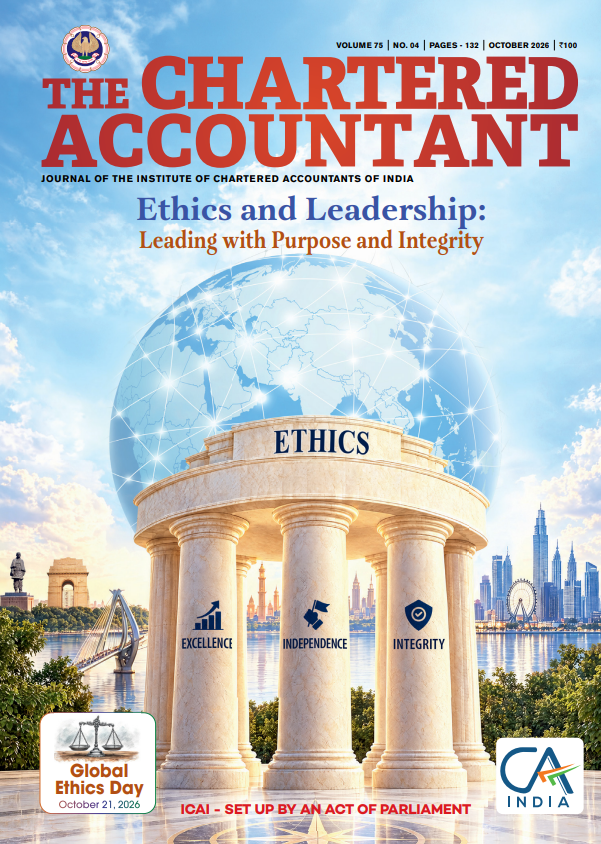 October
2026
· Vol. 75
· No. 04
October
2026
· Vol. 75
· No. 04